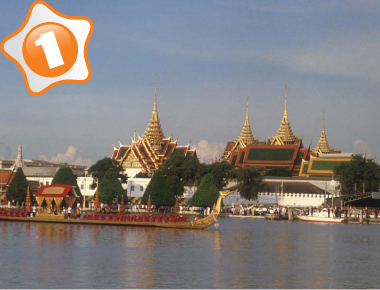
The water-borne procession involves barges carrying the deeply revered Buddha image (Phra Buddha Sihing) and the royal family to present robes to the monks at Wat Arun (Temple of Dawn) to mark Awk Phansa, the end of the three month Buddhist rains' retreat in October. During the rainy season, Buddhist monks traditionally return to their temples for what is often called Buddhist lent.
This annual pilgrimage, which usually takes place during the full moon in October and November, is known as Tawt Kathin Luang or the Royal Kathin Ceremony.
The water-borne royal kathin procession on October 22 will consist of a flotilla of 52 traditional- style barges arranged in five columns, based on a battle formation from ancient times. This is made up of four major royal barges – Suphannahongse, Narai Song Suban H.M. King Rama IX, Anantanagaraj and Anekchatbhuchongse, eight barges with animal figureheads and 40 smaller ceremonial barges. A total of 2,098 navy officers from various units within the Royal Thai Navy will serve as oarsmen. The royal barges of Thailand are the last of their kind in the world. The last time that a royal barge procession was organized was on June 12, 2006 for the diamond jubilee celebrations to mark the 60th anniversary of HM King Bhumibol's accession to the throne.
Throughout his long reign, HM King Bhumibol has devoted special attention to the preservation of the arts and culture of Thailand. On viewing the ruins of Ayutthaya, His Majesty once remarked: "Ancient ruins always do honour to a nation. Even an old brick from an ancient ruin is worthy of our preservation, for if we do not have Sukhothai, Ayutthaya and Bangkok, then Thailand itself does not mean anything."
The barges were badly damaged by allied bombing during World War II. Upon his return to Thailand in December 1951, HM King Bhumibol went to inspect the damage and condition of the barges in their dry dock on Bangkok Noi canal on the west bank of the Chao Phraya. The king was gravely concerned about the extensive deterioration of these historic vessels and commissioned their renovation. The ancient tradition of royal barge processions for nationally auspicious occasions was later revived. The waterways of Siam have served as highways for Thai people for centuries, and Thai life literally revolved around them. The origins of the royal barge procession date from the reign of King Ramkhamhaeng (reign 1275-1316 AD) in the Sukhothai era (circa 1238-1438). Descriptions of royal kathin ceremonies on both land and water have been described as far back as the Ayutthaya era (circa 1351-1767). By the mid-Ayutthaya years, the processions were conducted during the day. By the reign of Rama I (reign 1782-1809) in Bangkok, the rite had been combined with others for waterborne Buddha images.
Event : October 22.
Full dress rehearsal : October 13 & 18.
Contact Tel : +6602-2505500;
Website : www.tat.or.th; Email : info@tat.or.th |